Pediatric Dentistry
Pacifier use and dental alignment: separating fact from myth
Pacifier use does not automatically damage a child’s teeth. The dental concern is about a habit that continues over time: after about 18 months, regular sucking can influence how the teeth and jaws…
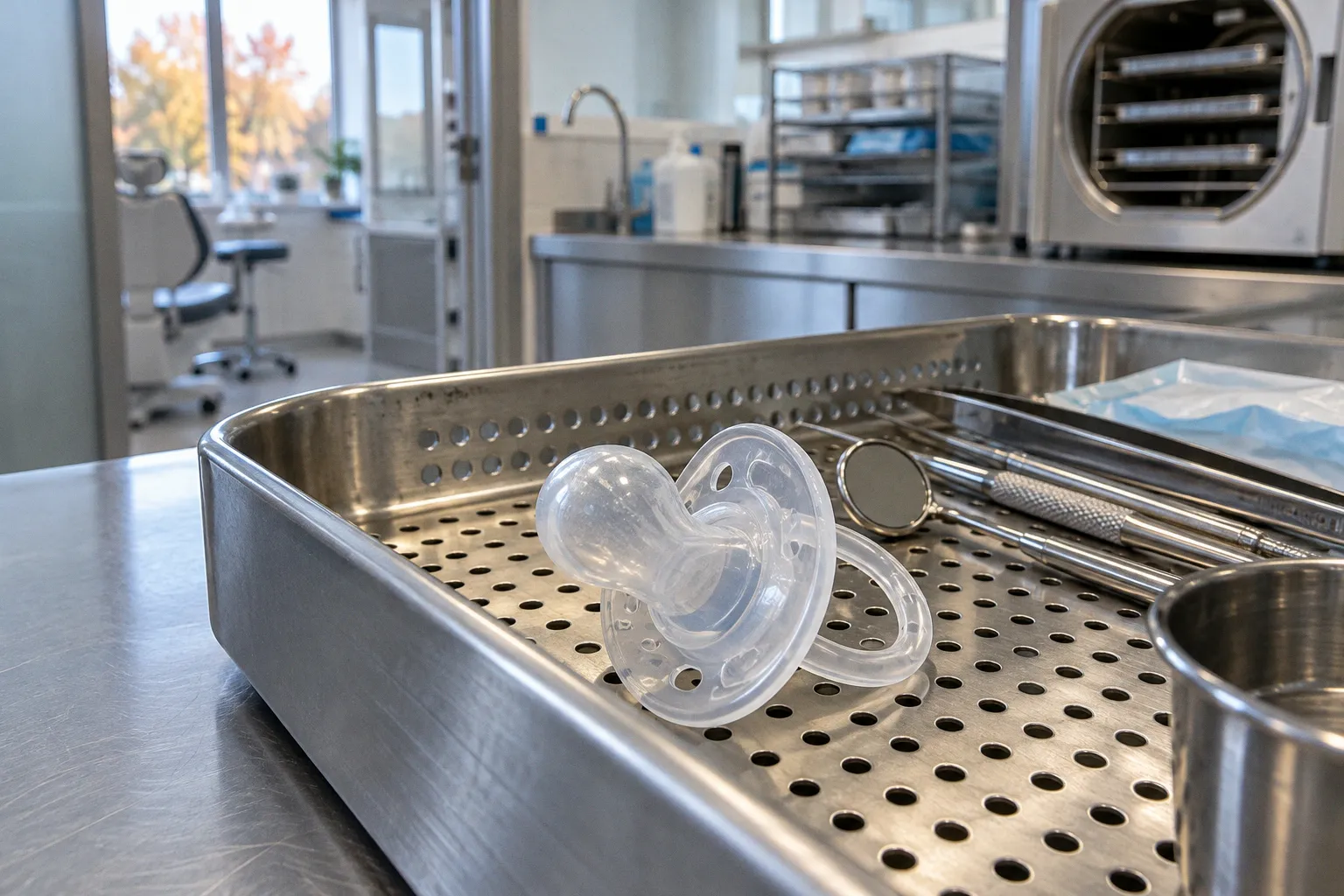
Pacifier use does not automatically damage a child’s teeth. The dental concern is about a habit that continues over time: after about 18 months, regular sucking can influence how the teeth and jaws develop, with risks including an anterior open bite or posterior crossbite. The American Academy of Pediatric Dentistry (AAPD) recommends ending nonnutritive sucking habits by 36 months.
That guidance is not a reason to panic about a pacifier used in infancy. Early use can help soothe a baby, and pacifiers may have a role in reducing the risk of sudden infant death syndrome (SIDS). For dental alignment, the practical question is usually not whether a child ever used a pacifier, but how long the habit continues and whether the child can gradually stop before age three.
Early pacifier use has a different purpose
Sucking is a normal way for infants to self-soothe. A pacifier can also be useful in specific early situations: the AAPD notes benefits that include supporting the sucking reflex in premature infants, providing comfort during minor procedures, and helping prevent a finger-sucking habit. Pacifier use during sleep is also associated with a reduced risk of SIDS.
These early benefits need to be considered separately from the effects of a prolonged habit on developing teeth. Advice about infant sleep and pacifier use should follow current guidance from a child’s healthcare provider. Dental concerns about continued use do not mean that a pacifier is inherently harmful in the first months of life.
Breastfeeding questions are also often part of the discussion. A Cochrane review found that, among healthy, full-term infants up to four months of age, pacifier use—whether started from birth or after lactation was established—did not affect the prevalence or duration of breastfeeding. That finding applies to the population and time period studied; it is not a substitute for individualized feeding advice if a baby is having difficulty nursing or gaining weight.
The dental plan can therefore proceed in stages: use a pacifier appropriately in infancy, monitor how the habit changes as the child grows, and work toward discontinuing it by the recommended age.
Why duration matters more than sucking strength
Parents sometimes focus on how vigorously a child sucks. For dental alignment, however, the AAPD identifies the duration of pressure—how many hours per day the habit is present—as more important than the intensity of sucking.
A child who sucks forcefully for a short time is not necessarily at greater risk than a child who keeps a pacifier in the mouth for much of the day or night. The pressure is applied to the teeth and developing oral structures while the habit is happening; repeated, prolonged exposure gives it more opportunity to influence their position. There is no established daily-hours threshold that can predict an individual child’s outcome, so it would be misleading to treat a particular number of minutes or hours as a universal safety limit.
In practical terms, assess the pattern rather than trying to measure the force:
- Notice whether the pacifier is mainly used for sleep or is present through much of the day.
- Observe whether the child can settle without it in some familiar situations.
- Monitor whether the habit is becoming more frequent or difficult to interrupt as the child gets older.
- Raise the pattern with a dentist if the child is approaching 18 months or the pacifier is used for extended periods.
This is not a diagnostic test a parent needs to perform. It is a way to describe the habit clearly at a dental visit so the clinician can assess oral development in context.
For dental alignment, the length of daily exposure matters more than how forcefully a child sucks.
What can change after 18 months
After 18 months, ongoing pacifier use is associated with a greater likelihood of certain bite changes. These include an anterior open bite, where the front teeth do not meet when the back teeth are together, and a posterior crossbite, where some upper teeth sit inside the lower teeth when biting. A Class II malocclusion—an alignment relationship in which the upper teeth or jaw sit forward relative to the lower—may also be more likely.
These terms describe possible patterns, not a prediction that every child who uses a pacifier will develop them. The 18-month point is a useful time to pay closer attention to duration and begin reducing the habit where possible. It does not mean that damage begins abruptly on a child’s 18-month birthday, or that a dentist can determine the future alignment of permanent teeth from pacifier use alone.
A dental home by 12 months gives families a place to discuss oral development before these questions become urgent. At routine visits, the dentist can look at the primary teeth and bite, ask how often the pacifier is used, and advise whether the child’s current pattern calls for a change. If a parent notices that the front teeth do not meet or the bite looks uneven, it is reasonable to mention it at the next visit rather than assume the pacifier is the sole cause.
The purpose of monitoring is to identify a pattern and respond at an appropriate time. It is not to label normal variation as a problem or to stop a pacifier abruptly because of one isolated observation.
Pacifier use compared with thumb sucking
Pacifiers and thumb or finger sucking are both nonnutritive sucking habits, but their effects and practical management are not identical. Thumb and finger habits are more strongly associated with increased overjet and Class II malocclusion than pacifier use. They can also be harder to stop because a child always has access to a thumb or finger, while a pacifier can be gradually limited and removed.
| Habit | Dental considerations | Practical feature |
|---|---|---|
| Pacifier | Continued use can be associated with open bite, crossbite, and Class II malocclusion, particularly as the child gets older. | Caregivers can manage when and where it is offered, then reduce access. |
| Thumb or finger sucking | More strongly associated with increased overjet and Class II malocclusion than pacifier use. | The habit is always available to the child and may be harder to interrupt. |
This comparison is not a reason to encourage one habit as a dental treatment for another. It helps explain why a pacifier may be easier to phase out, while a finger habit may need a different, patient approach. In either case, assess how often the habit occurs, monitor the bite during routine dental care, and avoid framing the child’s behavior as deliberate misbehavior.
Do orthodontic pacifiers prevent alignment problems?
The label “orthodontic” can sound like a guarantee, but it is not. Some pacifier designs may reduce the risk of certain dental changes compared with conventional designs, yet available evidence does not establish that any shape completely prevents malocclusion over the long term. Shape does not cancel out the effect of prolonged daily use.
If a family chooses an orthodontic-style pacifier, treat it as one product feature—not as permission to extend the habit beyond the usual weaning period. The same basic plan applies: monitor frequency and duration, begin reducing use as the child grows, and aim to discontinue nonnutritive sucking by 36 months. A dentist can discuss the child’s bite and habit at a routine visit, but no pacifier design should be presented as a substitute for that assessment.
The same caution applies to marketing claims that imply a product will protect alignment regardless of how long it is used. Evidence supports attention to the habit itself; it does not support a promise that one shape eliminates all risk.
When to stop and what may happen afterward
The AAPD recommends discontinuing nonnutritive sucking habits by 36 months. Other pediatric guidance commonly places pacifier weaning earlier, between 6 and 12 months, in part to reduce the risk of ear infections. These recommendations address different concerns and do not mean that every family must follow the same day-by-day schedule. Parents can discuss timing with the child’s healthcare provider, especially when the pacifier is serving an important soothing role.
For dental development, the key target is to stop before age three. Misalignment of primary teeth caused by a pacifier often corrects naturally if the habit ends before that age and before permanent teeth erupt. This is reassuring, but it is not a guarantee that every bite change will resolve without assessment. If a dentist identifies a concern, the clinician can monitor whether it improves or whether further evaluation is needed.
A gradual reduction can make the transition more manageable. Families may begin by limiting the pacifier to sleep or other predictable situations, then reduce those uses over time. Keeping the approach consistent helps caregivers implement the plan without turning each request into a new negotiation. If the habit continues despite these steps, ask the dentist or pediatrician for guidance rather than relying on a device or a promise of rapid correction.
A practical plan for maintaining oral development
Pacifier use is one part of early childhood oral development, not a verdict on a child’s future smile. The most useful approach is to match the response to the child’s age and pattern of use:
1. In infancy, use the pacifier in line with your child’s healthcare guidance. Its early soothing and other potential benefits are distinct from the dental concerns associated with prolonged use.
2. Establish a dental home by 12 months. Use visits to discuss primary teeth, bite development, and habits before a change becomes a source of uncertainty.
3. After 18 months, monitor duration and frequency. Prolonged daily use is more relevant to dental alignment than the force of sucking.
4. Start reducing the habit in a consistent way. Limiting use to selected situations can be a step toward discontinuation.
5. Aim to stop by 36 months, and ask for an assessment if the bite appears altered. Early cessation often allows pacifier-related changes in primary teeth to self-correct, but a dentist can advise on an individual child’s development.
The distinction is straightforward: early pacifier use is not the same as a prolonged habit. Families do not need to treat every pacifier as a threat, but they should monitor how long the habit continues and plan to end it by age three.