Advice for patients
Porcelain veneers vs composite bonding: durability comparison
The question of porcelain veneers vs composite bonding durability is not primarily a question of which material looks better on the day of placement.
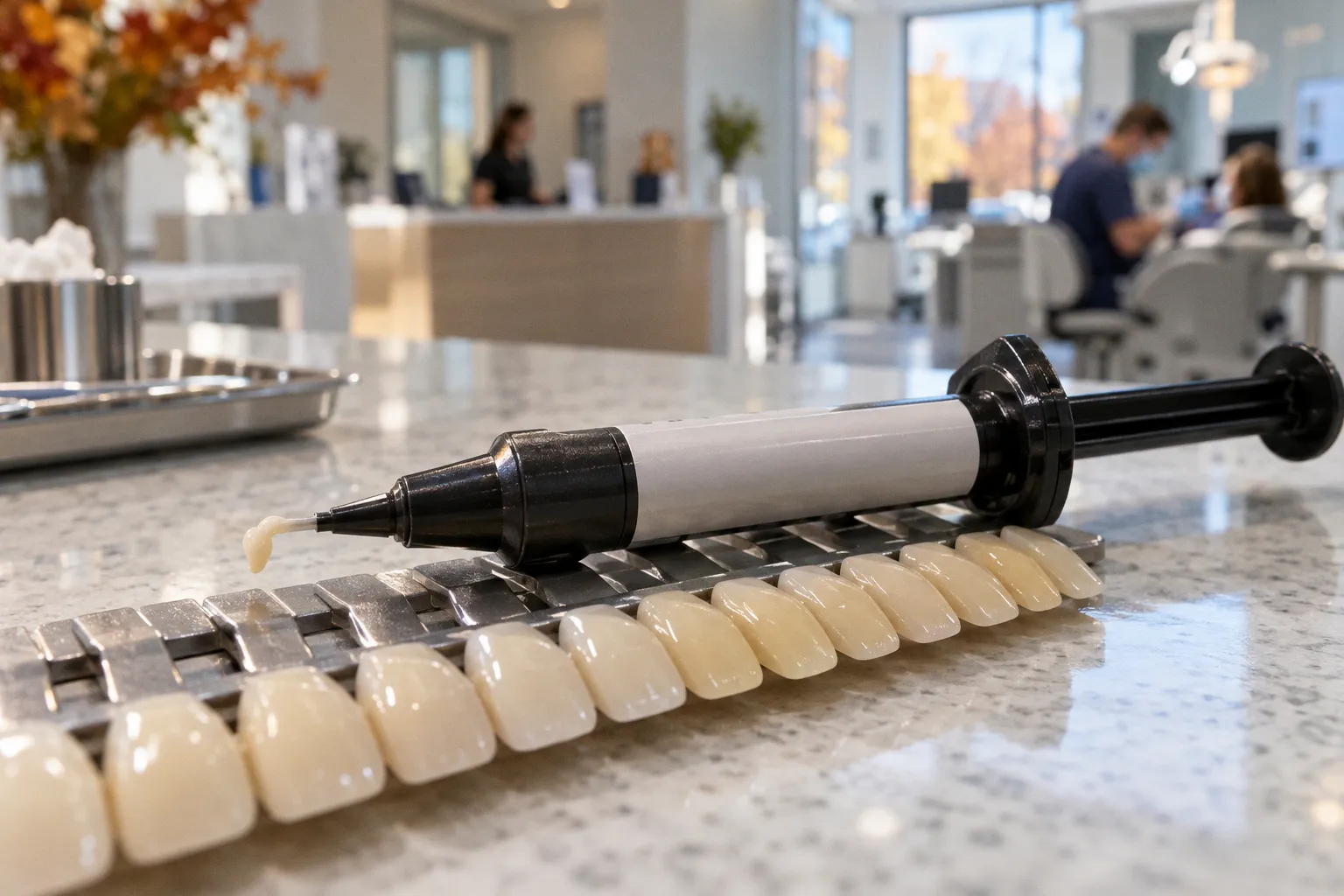
It is a question of how each material behaves under repeated loading, pigment exposure, saliva, thermal cycling, enamel constraints, and the patient’s occlusion.
Porcelain generally provides the longer service interval and greater resistance to staining, while composite bonding preserves more natural tooth structure and remains easier to repair. The distinction is structural: porcelain is a laboratory-fabricated ceramic restoration with a stable surface and controlled thickness; composite is a resin-based material placed directly on the tooth, shaped chairside, and more vulnerable to surface wear and pigment absorption.
Neither material is immune to fracture, marginal deterioration, or loss of gloss. The relevant comparison is how those failures occur, how they are managed, and what the replacement process requires when the restoration reaches the end of its useful life.
Material science and structural longevity
Traditional porcelain veneers are thin ceramic shells bonded to the facial surface of the tooth. Their mechanical performance depends on several variables that are not visible in a photograph: the thickness and uniformity of the ceramic, the quality of the enamel bond, the preparation design, the position of the incisal edge, and the distribution of occlusal forces.
Composite bonding uses a resin matrix containing inorganic filler particles. The dentist applies the material directly to the tooth, incrementally builds the contour, and polymerizes it with a curing light. Its advantages are procedural flexibility and conservation of enamel. Its limitations arise from the material’s greater susceptibility to abrasion, chipping, water absorption, and surface roughening.
The expected lifespan reflects those differences:
| Parameter | Porcelain veneers | Composite bonding |
|---|---|---|
| Typical service life | Approximately 10 to 15 years | Approximately 4 to 8 years |
| Longer-term performance | Some restorations remain functional for 20 years or more with appropriate care | Usually requires repair, polishing, or replacement sooner |
| Resistance to staining | High, provided the ceramic surface and margins remain intact | Lower; resin can absorb pigments and lose gloss |
| Enamel preparation | Traditionally about 0.3 mm to 0.7 mm | Minimal or none in many cases |
| Repair after fracture | Usually requires complete replacement | Often repairable or re-sculptable chairside |
| Initial cost range | Approximately $925 to $2,500 per tooth | Approximately $100 to $400 per tooth |
| Biological reversibility | Irreversible when enamel has been removed | More conservative, although bonding itself is not always entirely reversible |
A porcelain veneer is not simply a harder version of composite. It has a different failure pattern. Ceramic tolerates surface staining well but is unforgiving when a crack propagates through the restoration or when a substantial portion of the veneer fractures. Composite, by contrast, may degrade gradually through edge wear, roughness, discoloration, or small chips that can be corrected without removing the entire restoration.
Long-term clinical data commonly report that approximately 90% to 96% of porcelain veneers remain fully functional at ten years. That statistic describes a population result, not a guarantee for an individual tooth. Incisor position, parafunctional activity, enamel availability, hygiene, restoration design, and the patient’s willingness to use protective measures all alter the prognosis.
Porcelain usually fails later but more decisively; composite usually fails earlier but with more opportunities for repair.
The material’s durability is therefore only one part of the calculation. The adhesive interface and the force environment may matter more than the nominal hardness of the restoration.
Why porcelain maintains its surface longer
Aesthetic durability is not the same as fracture resistance. A restoration can remain attached to the tooth while becoming visually unstable because its surface has roughened, its margins have discolored, or its optical behavior no longer matches adjacent enamel.
Porcelain has a dense, relatively inert surface. When properly glazed or polished, it reflects and transmits light in a stable manner. Its translucency can be engineered through the ceramic layering, thickness, and shade selection. It does not absorb coffee, tea, or red wine pigments in the same way that a resin matrix can.
Composite resin is more dependent on the integrity of its surface polish. The filler particles and resin matrix respond differently to abrasion. As the softer resin component wears, filler particles may become exposed or dislodged. The result is a micro-texture that collects pigment and scatters light irregularly. The restoration may appear darker, less uniform, or less integrated with neighboring enamel even when its basic contour remains acceptable.
This is why composite bonding resistance to staining is lower than that of porcelain. The issue is not that every composite restoration will become visibly discolored within a short period. It is that composite has more pathways to color change:
- The resin matrix can absorb chromogens from frequently consumed beverages and foods.
- Repeated brushing, abrasive toothpaste, and chewing can reduce surface gloss.
- Marginal areas may accumulate plaque and develop localized discoloration.
- Small chips and roughened regions create additional retention sites for pigment.
- The shade selected at placement may become mismatched if natural adjacent teeth change over time.
Porcelain is not chemically bleach-proof in the broader sense, but the ceramic itself does not respond to whitening gel as natural enamel does. Once a veneer is placed, professional or at-home bleaching can lighten the surrounding natural teeth without changing the intrinsic shade of the porcelain. The same limitation applies to composite. Whitening should therefore be planned before definitive shade selection when the patient wants a lighter overall result.
The optical problem becomes more complex when restorations are placed on only one or two teeth. A small difference in translucency, value, or surface texture can be more conspicuous than a difference in hue. A veneer that is slightly too opaque may look artificial under direct light; a composite restoration that has lost its polish may create a darker optical zone near the gingival margin. These are not simply color errors. They are failures of light management across the facial surface.
Enamel preparation and the adhesive interface
The durability of porcelain veneers is closely connected to where the restoration is bonded. Enamel provides a more predictable adhesive substrate than dentin because it is mineral-rich, dryable, and less affected by fluid movement. Traditional veneer preparation removes approximately 0.3 mm to 0.7 mm of enamel, depending on the treatment design, the existing tooth position, the desired change in contour, and the thickness required for the ceramic.
That reduction makes porcelain veneer treatment permanent. The natural enamel does not regenerate, and the tooth will generally require a replacement veneer or another form of restoration once the original ceramic can no longer be maintained.
Composite bonding can often be performed with little or no enamel reduction. The dentist may roughen the surface, selectively etch enamel, apply an adhesive system, and build the resin directly onto the tooth. This allows the treatment to preserve more natural structure and to accommodate future changes in shape or shade with less extensive intervention.
However, minimal preparation does not eliminate technical sensitivity. Composite durability can be reduced when the bonding field is contaminated by saliva, when the resin is under-cured, when the material is placed in excessive bulk, or when the final contours create unfavorable contact with the opposing teeth. An apparently conservative procedure can still produce premature wear if the incisal edge is placed directly into a heavy functional path.
The margin also deserves forensic attention. A smooth, well-adapted gingival margin is easier to clean and less likely to retain plaque. An overcontoured composite restoration can create a shadowed cervical zone and make flossing difficult. A porcelain veneer with an imprecise margin can produce similar biological problems, despite the ceramic’s superior surface stability.
The material is not the sole determinant of the outcome. The restoration must fit the anatomy and the occlusion that will act on it every day.
Clinical survival versus cosmetic maintenance
The lifespan of dental veneers is often discussed as if the restoration either survives or fails. In practice, there are at least three different endpoints:
1. Functional survival: the restoration remains attached and structurally usable.
2. Cosmetic survival: the shade, gloss, contour, and symmetry remain acceptable.
3. Biological acceptability: the margins remain compatible with periodontal health and can be maintained with routine hygiene.
A porcelain veneer may remain technically functional while its gingival margin becomes visible because the gum tissue changes position. It may also remain intact while the adjacent natural tooth darkens or the underlying tooth structure alters the perceived value of the veneer. Composite may remain bonded but require polishing because its surface has become matte or stained.
This distinction matters when comparing material longevity. A ten-year survival rate does not mean that every veneer looks unchanged for ten years. Maintenance visits may still include occlusal checks, professional polishing of adjacent surfaces, plaque control, and evaluation of the gingival margins.
Composite generally requires more frequent maintenance because its surface condition changes sooner. Polishing can restore some gloss, but it cannot always reverse intrinsic discoloration or repair a large loss of contour. If the resin has absorbed pigments throughout its matrix, external polishing may improve the surface without returning the original shade.
Porcelain’s resistance to staining reduces one category of maintenance, but it does not remove the need for monitoring. Ceramic can chip, debond, or fracture. The bonding interface can deteriorate if the patient repeatedly loads the edges, and the surrounding tooth remains susceptible to caries and periodontal inflammation.
A realistic maintenance schedule is shaped by the patient’s risk profile:
- A patient with stable occlusion, good enamel support, and no parafunctional habits may maintain either restoration more successfully.
- A patient who clenches, grinds, bites objects, or uses the incisors to open packaging exposes both materials to premature damage.
- A patient with frequent coffee, tea, or red wine intake may notice surface staining sooner with composite.
- A patient with active gingival inflammation may experience margin problems regardless of whether the restoration is ceramic or resin.
- A patient who repeatedly changes the desired tooth shade may face a mismatch with existing restorations because neither porcelain nor composite can be lightened by bleaching after placement.
The most accurate comparison is therefore not “long-lasting versus short-lasting.” It is “stable surface with irreversible replacement versus serviceable surface with more frequent intervention.”
Fracture, repair, and replacement
The difference between repairability and replaceability is central to the porcelain veneers vs composite bonding durability decision.
Composite is added directly to the tooth. If a small portion chips, the dentist can often roughen the existing material, condition the surface, add fresh resin, shape the repair, and polish the area in a single chairside appointment. The repair may not be invisible under close inspection, particularly if the original composite has aged or changed color, but the tooth does not automatically require complete restoration removal.
Composite can also be re-sculpted. Minor asymmetries in incisal length, line angles, or surface texture may be adjusted by selective removal and additional resin. This flexibility is valuable when the desired result is conservative and the patient accepts periodic maintenance.
Porcelain behaves differently. A superficial issue such as a small margin irregularity may sometimes be managed without replacing the entire restoration, depending on its location and depth. A true fracture through the ceramic, however, cannot be repaired by simply gluing the broken segment back into structural reliability. A fractured veneer generally requires complete replacement.
Replacement also involves a new assessment of the tooth beneath it. The original preparation may have altered the enamel geometry, and the replacement must account for the available bonding substrate, the condition of the margins, and any change in occlusion. If the tooth has suffered decay, fracture, or adhesive failure, the new restoration may require a revised design.
This asymmetry has practical consequences:
- Composite has a lower entry cost and a more forgiving repair pathway.
- Porcelain has a higher initial cost but a longer expected service interval.
- Composite repairs can accumulate over time, with shade and surface texture becoming less uniform.
- Porcelain replacement is more disruptive when fracture occurs, but replacement is not typically needed as frequently when the case is well selected.
- Neither material should be presented as maintenance-free.
The cost-effectiveness of dental veneers depends on the time horizon. Using the supplied cost ranges, composite bonding may cost approximately $100 to $400 per tooth, while porcelain veneers may range from approximately $925 to $2,500 per tooth. These figures are broad benchmarks rather than a quote for a specific clinic or treatment plan. Number of teeth, diagnostic records, temporary restorations, laboratory fees, occlusal therapy, and replacement needs can materially alter the total.
A lower initial price does not automatically make composite the less expensive long-term option. Conversely, a longer ceramic lifespan does not guarantee better value if the patient has untreated bruxism or an unstable bite that repeatedly damages restorations.
Bruxism is the main durability variable
Untreated nighttime teeth grinding is one of the leading causes of premature chipping and failure for both porcelain and composite restorations. The material changes, but the mechanical problem remains: repeated loading is applied to surfaces that were not designed to absorb uncontrolled parafunctional forces.
Bruxism may produce:
- Flattened incisal edges.
- Fine cracks in enamel or ceramic.
- Chipping at the incisal corners.
- Loss of composite contour.
- Debonding at the veneer margin.
- Muscle tenderness or morning jaw fatigue.
- Progressive changes in the occlusal relationship.
Porcelain is harder and more wear-resistant than composite, but that does not make it indestructible. A rigid ceramic edge placed against a heavy opposing contact can fracture under a force pattern that would have caused composite to deform or chip. Composite may sacrifice material sooner but can sometimes be repaired without replacing the entire restoration.
A custom night guard is commonly the most protective measure for extending restoration longevity when grinding is present. It should not be treated as an optional accessory added after damage has occurred. The design must provide adequate separation and stable contact without creating new interferences. A poorly fitting guard can be uncomfortable, unused, or mechanically unhelpful.
Daytime habits also matter. Nail biting, chewing ice, holding pens between the teeth, tearing plastic packaging, and repeatedly biting hard objects can concentrate force on the same incisal zones. These habits create localized stress rather than evenly distributed loading, which is particularly unfavorable for thin ceramic margins and composite incisal additions.
The correct restorative material cannot compensate for an untreated force environment. In a patient with significant parafunction, the diagnostic phase should address the cause and the load pattern before the final aesthetic design is approved.
Which material provides the more rational long-term result?
Porcelain is usually the stronger option when the priority is a stable surface, high stain resistance, controlled translucency, and a longer interval before replacement. It is particularly rational when the patient accepts irreversible enamel preparation and has an occlusion that can support the planned ceramic design.
Composite bonding is usually the more rational option when enamel preservation, lower initial cost, and repairability carry greater weight. It can be appropriate for limited reshaping, small defects, modest changes in tooth proportions, and situations in which the patient wants to test a contour before committing to ceramic. Its expected service life is shorter, and its surface generally requires more maintenance.
The decision can be organized around the actual constraints rather than a generalized preference:
| Clinical priority | More favorable material | Reason |
|---|---|---|
| Maximum preservation of natural enamel | Composite bonding | Often requires minimal or no enamel reduction |
| Longer color and gloss stability | Porcelain | Ceramic surface resists pigment absorption and surface degradation |
| Lowest initial treatment cost | Composite bonding | Lower per-tooth cost range |
| Straightforward repair of a small chip | Composite bonding | Fresh resin can often be added chairside |
| Long service interval under stable conditions | Porcelain | Typical lifespan is approximately 10 to 15 years |
| Ability to revise contour without replacing a shell | Composite bonding | Material can be selectively removed and re-sculpted |
| High risk of staining exposure | Porcelain | Less susceptible to intrinsic pigment absorption |
| Untreated bruxism | Neither until managed | Force control is required before definitive restoration |
A technically sophisticated treatment plan should also account for the facial midline, tooth axis, incisal plane, gingival margins, and the relationship between tooth width and visible height. A material can be durable and still produce an unstable result if the design exaggerates asymmetry or creates abrupt transitions in light reflection.
The most predictable aesthetic result often comes from treating fewer variables at once. If tooth position, gingival levels, shade, and occlusion all require major alteration, veneers or bonding alone may not solve the underlying geometry. Clear aligner orthodontics, gum contouring, enamel microabrasion, or professional whitening may be better used before restorative treatment, depending on the diagnosis.
A realistic timeline of wear and degradation
Porcelain veneers typically enter a longer phase of relative surface stability. The ceramic may retain its gloss and resistance to external staining for many years, while the surrounding oral environment continues to change. Gingival position, adjacent tooth shade, occlusal contacts, and the condition of the bonding interface require periodic review.
Composite bonding usually shows a more progressive pattern. The first changes may be subtle: reduced gloss, slight edge wear, isolated staining near the margin, or a small alteration in incisal contour. Later, repeated polishing and repair can produce differences in texture or shade between older and newer resin. The restoration may remain serviceable, but the maintenance burden increases.
The typical time frames should be interpreted as ranges:
- Porcelain: approximately 10 to 15 years is a common expectation, with well-maintained restorations sometimes functioning for 20 years or more.
- Composite: approximately 4 to 8 years is a reasonable broad range before substantial repair or replacement becomes more likely.
- Both materials: failure can occur earlier with severe bruxism, poor hygiene, inadequate bonding, unfavorable occlusion, or traumatic habits.
- Neither material: can be whitened predictably with bleaching gel after placement; the synthetic restoration will retain its original shade while natural enamel may change.
Long-term success is not achieved at the delivery appointment. It is preserved through stable occlusion, controlled forces, meticulous hygiene around the gingival margins, regular dental examinations, and prompt attention to small defects before they become structural failures.
Final assessment
Porcelain veneers offer the stronger durability profile for surface stability, stain resistance, and long-term aesthetic continuity. Their principal liabilities are irreversible enamel preparation, higher initial cost, and full replacement when the ceramic fractures. Composite bonding is more conservative, less expensive initially, and more forgiving when repair is required, but its resin surface is more vulnerable to staining, loss of gloss, wear, and repeated maintenance.
For a patient with adequate enamel, controlled occlusion, realistic expectations, and a preference for a longer service interval, porcelain is generally the more durable material. For a patient prioritizing conservation of tooth structure, reversibility of design decisions, or economical correction of limited defects, composite may be the more defensible choice.
The material should follow the anatomy and force pattern, not the other way around. Durability is ultimately determined by the quality of the bond, the geometry of the restoration, the behavior of the patient’s bite, and the maintenance required after the initial aesthetic result has become routine.