Restorative & Implants
Dental bridge placement: what to expect during your visit
A conventional dental bridge is usually completed over 2 to 3 office visits, with about 2 to 4 weeks between preparation and placement of the permanent restoration. The interval is used to fabricate the bridge in a dental laboratory.
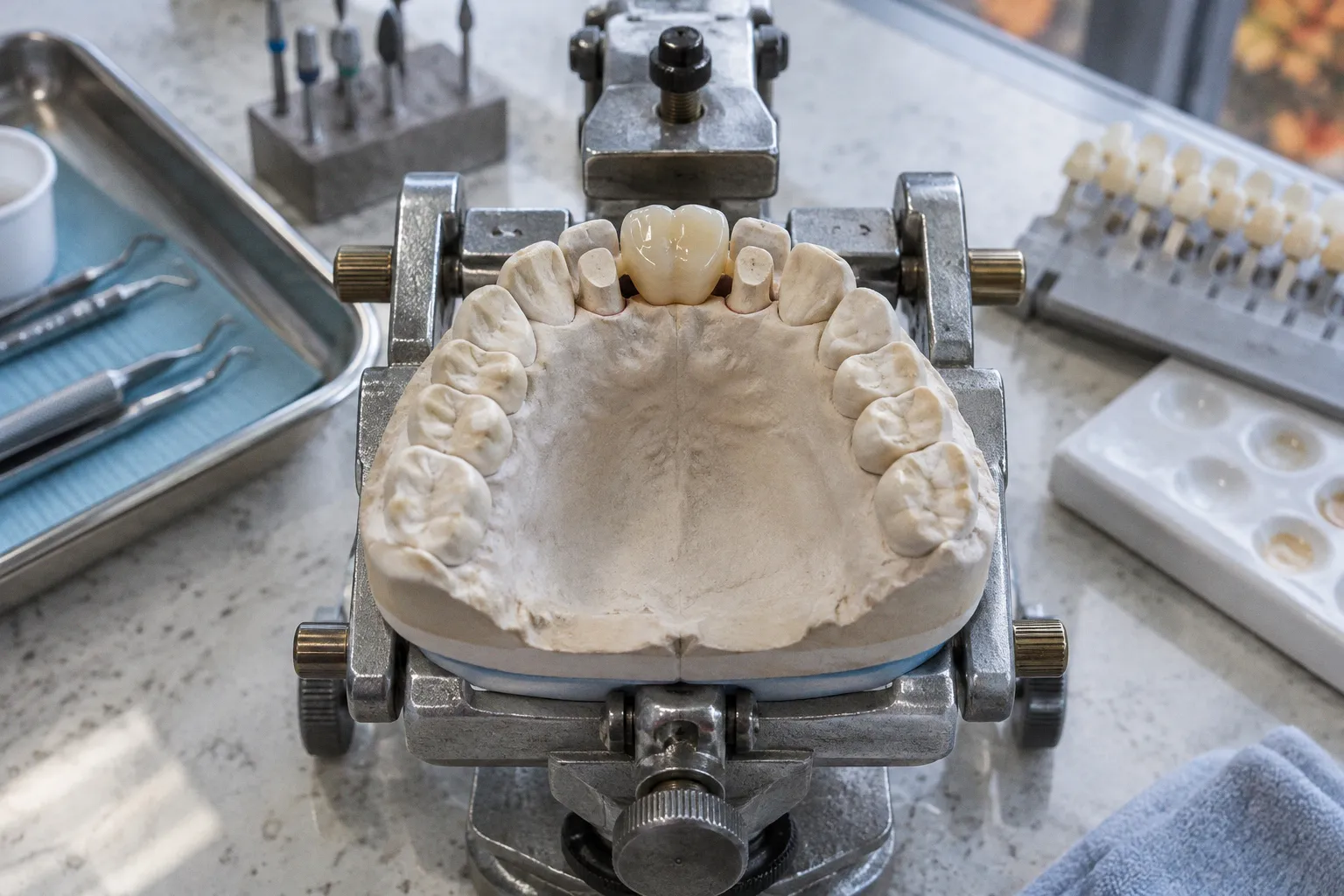
During the first visit, the teeth that will support it are reshaped; during the final visit, the dentist checks fit and bite contact before cementing the bridge.
The dental bridge procedure preparation steps depend on the condition and position of the supporting teeth, the number of missing teeth, and the selected material. A traditional bridge is not an implant: it rests on natural teeth prepared to receive crowns. That distinction affects the procedure, the load-bearing design, and what happens to the supporting teeth.
The initial consultation and abutment tooth preparation
Before preparation, the dentist assesses the gap and the teeth on either side of it. These supporting teeth are called abutments. They must be suitable for the forces transmitted through the bridge. The evaluation may include an examination of the teeth and gums, imaging, and a discussion of the proposed restoration. The specific tests depend on the clinical findings.
The design is not determined by the gap alone. A tooth with extensive decay, a large existing restoration, a crack, or reduced periodontal support may not provide the same foundation as an intact tooth. The dentist must decide whether the abutments can carry the bridge’s functional load and whether another treatment is needed first. If the plan includes several connected replacement teeth, preparing for a multi-tooth bridge also means assessing how the span and support points affect stability.
For a conventional tooth-supported bridge, the abutment teeth are reduced so there is room for the crowns that hold the replacement tooth or teeth. This is done under local anesthesia. Enamel and some underlying tooth structure are removed; the amount and shape of reduction depend on the restoration design and the material. The preparation creates a defined surface for the laboratory-made bridge to fit over.
That step has a lasting consequence: the supporting teeth have been altered and will need coverage. It is not accurate to describe the procedure as simply filling the empty space, nor is preparation equivalent to implant surgery. In a conventional bridge, the load is transferred through the abutment teeth rather than through an implant placed in the jaw.
A patient can prepare for the appointment by sharing a current medication list, relevant medical conditions, and any history of problems with local anesthetics or dental treatment. The clinic can advise whether any medication instructions apply. Do not stop or change a prescribed medicine on your own. If the treatment plan or expected sequence is unclear, ask the dentist to explain which teeth will be prepared and what temporary restoration will be used.
The key procedural change occurs at the abutments: a conventional bridge replaces a missing tooth by relying on prepared natural teeth for support.
Impressions and laboratory fabrication
Once the abutment teeth have been prepared, the dentist records their shape and the surrounding bite relationship. Dental impressions or molds are sent to a laboratory, along with information needed to construct the permanent bridge. The dentist also matches the restoration’s shade to the surrounding teeth.
The laboratory stage converts the clinical preparation into a custom restoration. The bridge must fit the prepared abutments and make appropriate contact with opposing teeth. A restoration that does not seat correctly or interferes with the bite may require adjustment before cementation. The fit is therefore a mechanical requirement, not just a matter of appearance.
The dental bridge appointment timeline commonly includes a waiting period of 2 to 4 weeks while the laboratory fabricates the permanent bridge. The exact schedule can vary with the case and the clinic’s workflow. If the bridge involves multiple replacement teeth or a more complex design, the dentist can explain whether the planned fabrication period differs.
At the first visit, the dentist generally places a temporary bridge or temporary crowns over the prepared abutments. These protect the teeth and provide a provisional replacement while the permanent restoration is being made. A temporary restoration is not the finished bridge. Its fit, strength, and expected service are different, so it should be treated according to the clinic’s instructions.
What to expect with a temporary bridge
The temporary bridge covers prepared teeth during the laboratory interval. It helps protect them and restores the space provisionally, but it does not have the same status as the final restoration. The dentist will explain how to care for it and what to do if it loosens, fractures, or causes persistent discomfort.
Follow the clinic’s instructions for eating and cleaning. Avoid pulling or levering on the temporary bridge when cleaning around it, and contact the dental office if it becomes displaced. Do not try to secure it with household adhesives. The right response depends on the type of temporary restoration and the condition of the prepared teeth.
Some sensitivity after preparation can occur, but symptoms should be interpreted in context. Increasing pain, swelling, a damaged temporary, or a change in the bite warrants a call to the clinic rather than an assumption that the problem will resolve on its own. A temporary bridge is a protective interim device; it is not a substitute for the planned fitting of the permanent bridge.
For pre-procedure care for dental bridges, there is usually no special home preparation beyond following the clinic’s instructions and arriving with relevant health information. The dentist may provide individual directions based on the patient’s medical history or the planned treatment. General instructions found online should not override those directions.
Final fitting, bite adjustment, and cementation
At the second main appointment, the temporary bridge is removed and the permanent bridge is tried in. The dentist checks how it sits on the abutment teeth, whether the restoration aligns with the neighboring teeth, and how the upper and lower teeth meet when the patient bites. These checks identify pressure points or contacts that need adjustment.
The fit should be assessed before permanent cementation. If the bridge does not seat properly or the bite contact is not acceptable, the dentist may adjust it or arrange further laboratory work. Cementing a restoration that is not correctly positioned would make correction more difficult. Once the fit and bite are satisfactory, the bridge is bonded with dental cement.
The final visit is not simply a handoff from the laboratory. It is a clinical verification step. A bridge can be fabricated to the submitted design and still need adjustment in the mouth, because the dentist must confirm its relationship to the actual abutments and opposing teeth. After cementation, the dentist may provide instructions on eating, cleaning, and what sensations to monitor.
The typical sequence is:
1. Assessment and planning. The dentist evaluates the gap, supporting teeth, gums, and bite, then selects a bridge design.
2. Abutment preparation. Under local anesthesia, the supporting teeth are reduced to create room for crowns.
3. Impressions and shade selection. The prepared teeth and bite are recorded for the laboratory.
4. Temporary coverage. A temporary bridge or crowns protect the prepared teeth during fabrication.
5. Permanent bridge fitting. The dentist checks seating, alignment, and bite contacts, makes necessary adjustments, and cements the restoration.
This sequence describes a conventional tooth-supported bridge. An implant-supported bridge follows a different treatment pathway because implants must be placed in the jaw; it should not be assumed to be part of routine tooth-supported bridge placement.
Longevity and maintenance
A traditional dental bridge typically lasts between 5 and 15 years. This range is not a service-life guarantee for an individual restoration. Material, placement, the condition of the abutments, and oral hygiene all affect how long the bridge remains serviceable. A bridge may remain intact while a supporting tooth develops decay or another problem, so the condition of the abutments matters alongside the condition of the prosthesis itself.
Daily cleaning needs to reach the areas around the supporting crowns and beneath the replacement tooth, where plaque and food debris can collect. The dentist or hygienist can demonstrate an appropriate method for the specific bridge design. Routine dental examinations allow the clinic to assess the restoration, its margins, the supporting teeth, and the surrounding gums. If the bite changes or the bridge feels loose, arrange an assessment rather than waiting for a routine visit.
Cost cannot be specified from the procedure sequence alone. It varies with location, insurance coverage, material selection, and the number and design of replacement teeth. A useful estimate should describe the planned restoration and what is included in the treatment, rather than rely on a generic price for a “bridge.”
The clinical trade-off is direct. A conventional bridge can replace a missing tooth without placing an implant, but it depends on prepared abutment teeth and transfers load through them. The procedure is clinically viable when the supporting teeth can carry that load and the restoration can be maintained. The decisive questions are whether the abutments are suitable, whether the bridge fits the bite, and whether the patient can clean and monitor it over time.